The message inside the message: a free sample of Cryptological Sociolinguistics (Chapters 1–5)
The message inside the message
Two adults are talking in the kitchen while the children play nearby. One of them says something ordinary, like “it depends on how Sunday turns out,” in a tone that is just slightly different, and the other nods without looking up. The children don’t know what happened. But they know something happened.
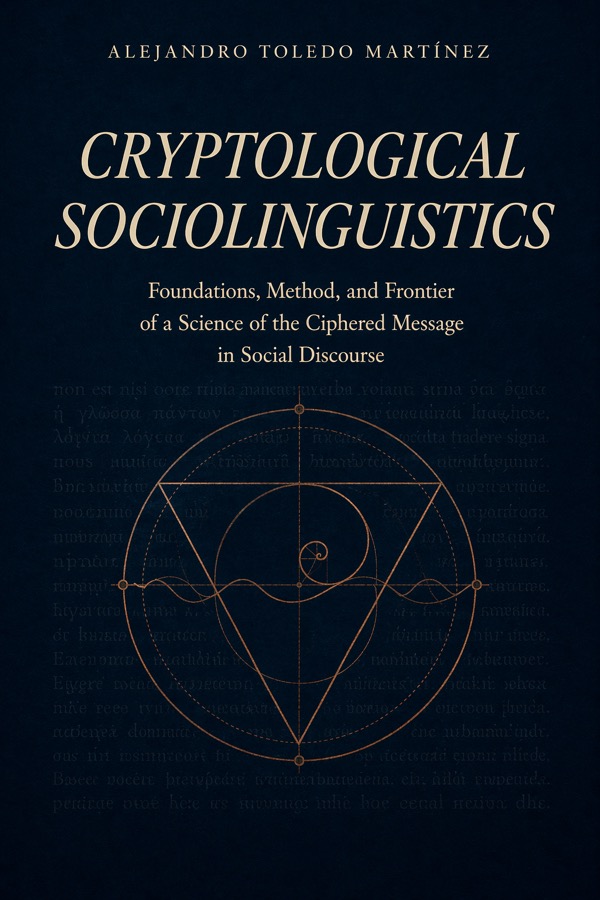
That domestic scene opens Cryptological Sociolinguistics: Foundations, Method, and Frontier of a Science of the Ciphered Message in Social Discourse. The first five chapters are now free to download from the Publications page, in English and in Spanish.
Four scenes, one structure
Chapter 1 takes the kitchen gesture out into public life through four scenes:
- The slogan that separates. “Law and order” in the late-1960s American South: a defensible surface for one half of the country, a promise of restoration for the other.
- The recipe that is not a recipe. Unalive on TikTok: a word built so that humans read it without effort and moderation algorithms, for a while, don’t.
- The ambiguous communiqué. Three paragraphs from a foreign ministry that the domestic public, an ally and the neighbouring state each read differently. None of the three readings contradicts the text, because the text was written so that none would.
- The symbol that crosses the threshold. A minimal gesture at a broadcast event. It means nothing to almost every viewer, and something specific to a small group trained in a symbolic tradition.
The scenes are very different, but they share a structure, and the book names its four features:
- Differential reading. Different audiences draw coherent but different readings from the same message.
- Plausible deniability. If challenged, the sender can always fall back on the literal reading.
- Hide effect. The general audience often doesn’t even suspect there is a code.
- Relevant intentionality. The coding has a purpose. It may be calculated, habitual or emergent, but it isn’t random.
The thesis fits in one sentence:
Every social message belongs, at least in part, to two economies: that of what is said, and that of what is transmitted without being said.
Cryptological sociolinguistics (CSS) studies the second economy.
Two borders
Most of Part I is about borders, and two of them explain why the discipline is needed at all.
Endolinguistics. Chapter 2 begins with an error committed in good faith. A colleague working on deep consonantal codes tried to explain the social effect of a political slogan by the consonantal ternary that organised it. The structure is real, and so is the slogan’s effect, but the straight line drawn between them is wrong. It merges a stable, pre-symbolic level of language with a conjunctural, pragmatic one. In the book’s analogy, a car needs four wheels to be a car, but the wheels don’t explain why it arrives late to an appointment.
The chapter separates three levels of the sign:
- Pre-symbolic structure: the level where endolinguistics works.
- Endolinguistic code: the analytic formalisation of that structure.
- Symbol: a sign that is historical, negotiable and culturally recognised.
Endolinguistics can say why a word exists and what it resonates with across a macrosystem. That resonance does not imply etymological kinship. CSS asks a different question: how the word is used today, in this context, with what purpose and what differential effect. There is a bridge between the two disciplines, but it runs in one direction only. Endolinguistics can inspire hypotheses. It cannot replace method, and it never licenses inferring social intentions from consonantal codes.
Endolinguistics was founded by C. S. Meulemans and J. Á. Elias. The book does not try to validate it. It takes the discipline as a working one, and its job here is to show where it ends.
The esoteric and oracular traditions. Chapter 3 maps ten families of traditions interested in hidden meaning, from Hermeticism and the divinatory arts to academic semiotics, memetics and conspiracy narratives. It measures each one’s distance from CSS on five dimensions: criterion of truth, falsifiability, unit of analysis, controls against overreading, and publication of negatives. The comparison condenses into a golden rule:
If the criterion of truth is initiatic or revealed, you are in esoteric hermeneutics, not in CSS. If the criterion of truth is public, replicable, and can come out negative, you are potentially in CSS.
From those traditions the book keeps one thing: the threshold. That is the formal fact that a sign circulates in a space where part of the audience holds the interpretive key and part does not. It discards any cosmology said to lie behind the threshold, which is how it can speak about esotericism without being esoteric.
An operational definition and a quick test
Chapter 4 gives the positive definition. A phenomenon belongs to CSS to the extent that it:
- produces differential readings;
- preserves the sender’s deniability;
- evades human or algorithmic filters;
- operates partly beneath what is socially conscious.
The criteria are a weighted filter, not a rigid lock. The chapter adds four kinds of converging evidence and a practical demarcation test:
If what you are studying is a word or consonantal code across several languages, you are in endolinguistics. If what you are studying is a full utterance, a communicative situation, a discursive strategy, or a timing, you are in cryptological sociolinguistics.
The worked example is a 1977 US communiqué that described a meeting as “a cordial and frank exchange of views.” The general public read warmth. In Cold War diplomatic usage, “frank” meant open disagreement. The case meets all four criteria, and the analysis stays deliberately modest: it doesn’t claim the sender acted in bad faith or that anyone was deceived. In the chapter’s words, CSS hypotheses are modest in scope, specific in content, falsifiable in method.
Why “cryptology”
Chapter 5 is a short history of human cryptography, from Histiaeus’s tattooed scalp and the Spartan scytale through Al-Kindi’s frequency analysis, Vigenère, Kerckhoffs, Enigma and Bletchley Park, to Diffie–Hellman and RSA. It ends with the social hacker, who gets the key by talking to the person who holds it rather than by breaking the algorithm.
The chapter also explains the book’s title by separating three terms:
- Cryptography: the craft of ciphering.
- Cryptology: in its broader sense, the study of the hidden.
- Cryptonymy: Abraham and Torok’s term for ciphering as something language itself does, with no conscious encipherer behind it.
CSS takes formal rigour from the first, a reflective vocation from the second, and from the third the suspicion that social codes do not always have an identifiable author.
The sample ends as Chapter 6, on Shannon’s model, begins.
Download the sample: Cryptological Sociolinguistics, free sample, Chapters 1–5 (PDF) · Versión en español
The complete book has six parts, twenty-nine chapters, a glossary, three appendices with worked examples, a bibliography and an analytical index. It is available at Independent Books.
Related on this site: Del código al aula: coderivados, los tres registros del sentido y la criptología sociolingüística · Criptología Sociolingüística y Estudios Oraculares